
Breaking Down Observability Costs: Randoli vs. New Relic, Datadog, & Dynatrace

Rajith Attapattu
October 6, 2025 · Updated September 27, 2026 · 4 min read
In short
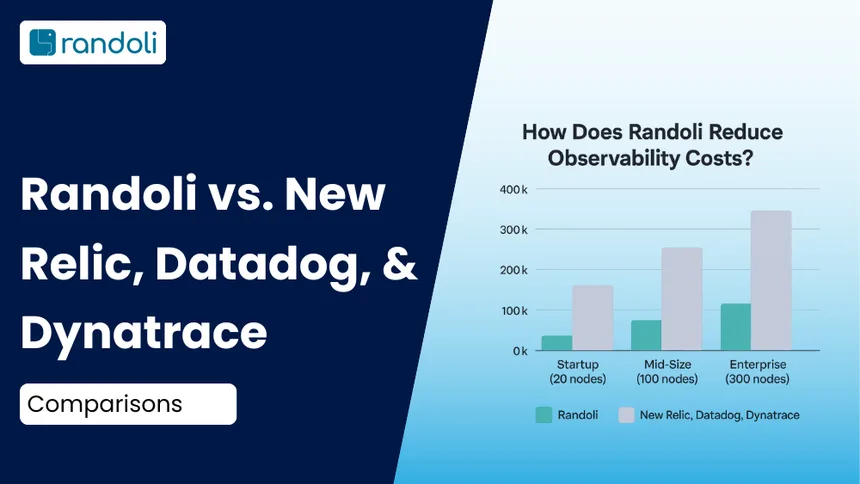
At 50 and 200 hosts with typical log and trace volumes, Datadog, New Relic and Dynatrace cost roughly two to two and a half times what Randoli does for infrastructure monitoring and APM. The difference is structural, not a discount: those vendors meter hosts plus data ingested, users or consumption units, while Randoli processes telemetry in your own environment and bills a flat $0.04 per host, per hour with no ingestion charge. You do still pay your own cloud provider for the storage your retention settings use.
As Kubernetes adoption grows, so does the cost of observing containerized workloads. Datadog, New Relic, and Dynatrace offer powerful tooling, but their bills grow with more than just the number of hosts you run: data ingested, users, and consumption units all add their own meters. Randoli takes a different approach, and the reason it costs less is architectural rather than a discount.
This article compares monthly observability costs for infrastructure monitoring and APM at three deployment sizes: 50, 200, and 500 hosts. It uses the same pricing and volume assumptions as our individual comparison pages, and explains which parts of the difference come from how each platform is built.
Updated September 2026 to reflect Randoli’s current pricing and architecture. An earlier version of this article priced Randoli with a per-GB ingestion charge; Randoli no longer has one.
Summary: Monthly Costs by Vendor
| Scenario | Randoli | Datadog | New Relic | Dynatrace |
|---|---|---|---|---|
| 50 hosts | ~$1,440 | ~$3,400 | ~$2,800 (10 Full Platform users) | ~$3,000 |
| 200 hosts | ~$5,760 | ~$13,600 | ~$13,500 (20 Full Platform users) | ~$11,500 |
| 500 hosts, enterprise | ~$14,400, volume discounts available | Quote-based | Quote-based | Quote-based |
Annualized, that’s about $17K for Randoli against $34K to $41K for the others at 50 hosts, and about $69K against $138K to $163K at 200 hosts.
Assumptions. About 300 GB of logs and 50 million trace spans per day for every 100 hosts, typical for a mid-size platform team. Competitor figures are estimates from each vendor’s published rate cards at standard pricing (Datadog infrastructure, log, and APM rates; New Relic ingestion plus Full Platform user seats; Dynatrace DPS rates for Full-Stack Monitoring with log ingest). Negotiated discounts, committed-use contracts, and free tiers will move all of these numbers, so treat them as a starting point for your own model rather than a quote.
What the Randoli column covers. Infrastructure monitoring and APM at $0.04 per host, per hour, where a host is up to 4 vCPU and 16 GB of memory (larger nodes are normalized proportionally). Cost Management ($0.03), Security ($0.02), and AI-powered incident management ($0.04) are priced per host, per hour on top if you add them.
Why the Cost Difference? There Is No Ingestion Step
The three platforms compared here are built around sending your telemetry to their cloud, and their pricing follows from that: once data is shipped, stored, and indexed on the vendor’s side, it makes sense to bill for it. That’s why each of them has a meter that grows with data volume or usage, on top of the host count.
Randoli is built the other way around. A data plane runs in your own environment, and logs, traces, and metrics are processed there, locally. Only derived signals reach Randoli’s control plane, never the raw telemetry. See Architecture for how the two planes fit together.
That changes the bill in three ways:
- No ingestion charge. There is no ingestion step, so there is nothing to meter. Adding log verbosity during an incident, instrumenting another service, or increasing trace sampling doesn’t change what you pay Randoli.
- No vendor-side storage or retention tiers. Logs and traces are stored in your environment, and you set retention based on your own capacity and compliance needs. Randoli doesn’t bill for retention.
- Far less data leaving your network. Because raw telemetry stays put, you’re not paying cloud egress fees to ship hundreds of gigabytes a day to a third party.
What Randoli’s Price Doesn’t Include
A fair comparison has to count what moves onto your own bill:
- Storage. The logs and traces you retain use disk or object storage in your own environment, billed by your cloud provider at your rates. How much depends on your volume and the retention you choose.
- In-cluster compute. The data plane runs as workloads in your clusters and uses some CPU and memory there.
For most teams these costs are a small fraction of per-GB ingestion and indexing charges, but they aren’t zero, and they belong in your model.
In-Cluster Log Analysis: Faster, Safer, Cheaper
Randoli analyzes logs inside your Kubernetes clusters instead of shipping them to the cloud first. Log Analyzers watch for the patterns you care about and raise an issue report when they fire.
This provides:
- Lower cost: No per-GB ingestion or indexing bill for the logs you analyze.
- Faster investigation: Querying close to the data avoids a round trip to a remote backend.
- Data sovereignty: Log data stays within your infrastructure, which simplifies compliance.
How Each Vendor’s Bill Grows
| Randoli | Datadog | New Relic | Dynatrace | |
|---|---|---|---|---|
| Primary unit | Host, per hour | Host, plus per-product add-ons | GB ingested, plus user seats | DPS consumption units |
| Ingestion | $0, processed locally | Billed per GB of logs and per indexed span | Billed per GB beyond the free tier | Billed as log ingest units |
| Users | Not billed per seat | Not the main driver | Billed per Full Platform user | Not the main driver |
| Retention | Set by you, on your storage | Longer retention costs more | Longer retention (Data Plus) raises the per-GB rate | Billed as retention units |
| What makes the bill jump | Adding hosts | Adding hosts, log volume, custom metrics, APM depth | Adding engineers or data volume | Adding capabilities such as logs, synthetics, or DEM |
For a deeper, vendor-by-vendor breakdown, see Randoli vs Datadog, Randoli vs New Relic, and Randoli vs Dynatrace.
Conclusion
At the scales compared here, Randoli costs roughly half as much as the alternatives for infrastructure monitoring and APM, and the gap widens as log volume, team size, or capability coverage grows, because those are exactly the axes the other vendors meter. The reason is where telemetry is processed: in your environment, with no ingestion step to bill for.
If you’re operating Kubernetes at scale, the most useful next step is to run these assumptions against your own host count, data volume, and team size. Our pricing page has the current rates, and every account starts with a 30-day free trial, no credit card required.