
Everything your stack needs, running inside your environment.
Logs, traces, and metrics are processed where they're generated. Randoli's control plane receives signals and insight, not the underlying telemetry, so your data never crosses into our environment.
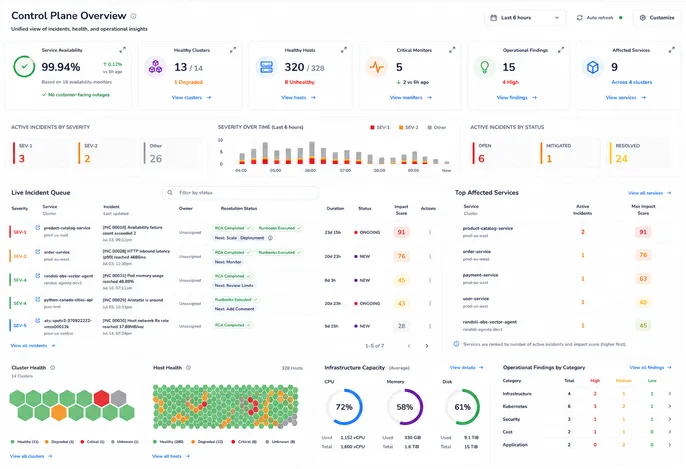
No charge for raw data volume because there's no ingestion step in the architecture.
Logs and traces are processed and stored in your environment, not ours.
Built on OpenTelemetry collectors from the ground up, Perses-compatible for visualization.
Teams resolve incidents 40% faster than their pre-Randoli baseline.
Capabilities
Federated control plane, local data processing, OpenTelemetry-native.
A pre-configured OTel pipeline, language coverage, and pipeline health monitoring.
Metric, log, and uptime monitors, all executing locally on your side of the wall.
Infrastructure, logs, APM, SLOs, anomaly detection, and alerts.
Cost visibility, idle workload detection, and chargeback reports.
CVE and CIS Benchmark posture alongside APM and cost, with anomaly detection on critical exposure spikes.
Signal correlation, root cause analysis, and executable runbooks.
Cloud providers, OTel backends, and incident response tooling.
Per-call cost and latency for models and agent steps, correlated with the rest of your stack.
Open by design
Randoli is built on OpenTelemetry from the collector up, and it's Perses-compatible for teams standardizing their visualization layer around that project. Nothing here asks you to give up the open standards you've already adopted.
Raiya, the SRE agent, sits on top of that pipeline. It has the context of a federated system already parsing your signals, which is what lets it cut MTTR by 40% instead of just surfacing more alerts.
Integrates with
Cloud & infrastructure
OpenTelemetry & backends
Workflow & incident response
Alerting